My Septic Alarm Is Going Off — Now What?
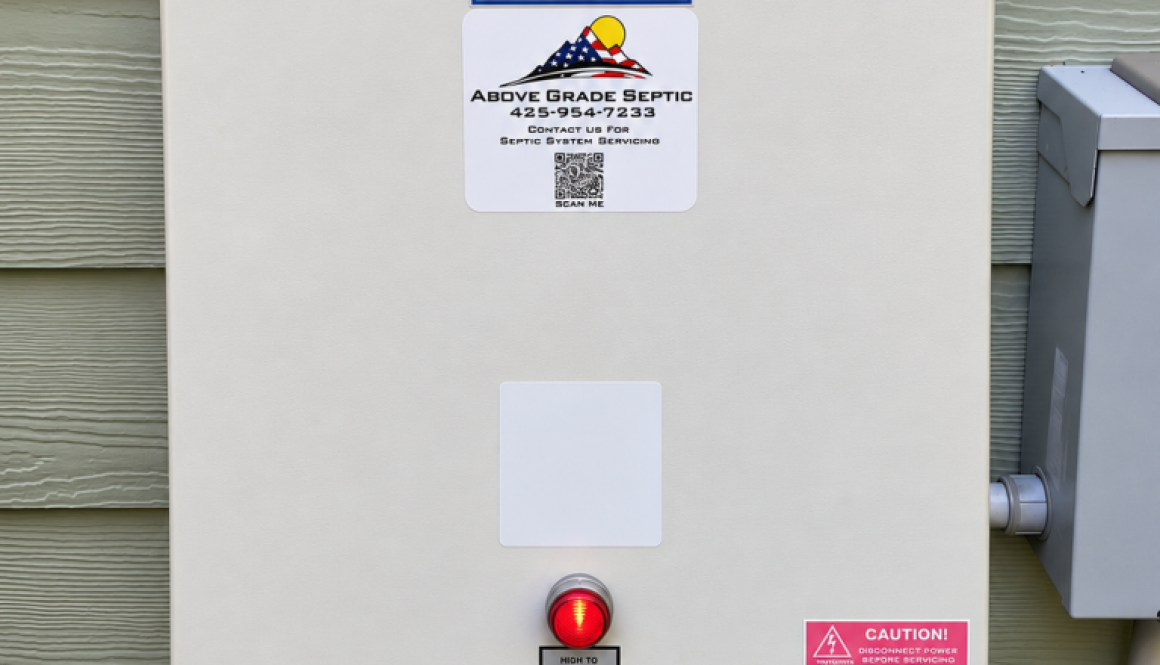
My Septic Alarm Is Going Off — Now What? (What to Do in the Next 10 Minutes)
It’s 9 p.m. Dinner’s done, the dishwasher’s running, and suddenly there’s a loud, insistent beeping coming from somewhere in the yard or the garage. A red light is flashing on a box you’ve walked past for years and never thought about.
Congratulations: you’ve just met your septic alarm.
First, take a breath. A septic alarm is not an emergency in itself. It’s an early warning, and the whole point of it is to give you time to act before anything actually backs up. Handle the next few minutes right and this is usually a simple fix.
We’re Above Grade Septic, and we’ve been answering “my alarm is going off” calls across Snohomish and King County since 2010. Here’s exactly what to do.
What the Alarm Is Actually Telling You
If your house has a septic alarm, you have more than a basic gravity system. You may have a pressure distribution system, a mound, an aerobic treatment unit (ATU), or a system with extra treatment like UV disinfection. And depending on the system, that alarm panel may be keeping an eye on several different components at once.
The most common things a septic alarm monitors:
- High water level in the pump chamber. The classic alarm. A float rises too high because the pump isn’t moving water out fast enough, or at all.
- High water level in an ATU or treatment tank. ATUs have their own chambers, and a backed-up filter, clarifier or failed component can cause levels to climb.
- The air compressor or blower. ATUs depend on a steady supply of air to keep the treatment bacteria alive. Many panels sound an alarm when air pressure drops or the blower stops.
- The UV disinfection unit. Systems with UV treatment often alarm when the lamp burns out or stops working, since the water leaving the system is no longer being disinfected.
- Pump run time or timer faults. Systems that dose on a timer may alarm when the pump runs too long, too often or not at all.
- Control panel or power problems, like a tripped circuit feeding one of the components.
Many panels have separate lights, labels or codes for each of these. Before you do anything else, look at which light is on. It’s the single most useful clue you (and we) can have.
The good news: in most cases the alarm is an early warning. It’s giving you time to act before something backs up or untreated water reaches your drainfield.
What to Do Right Now, Step by Step
- Silence the alarm. Most panels have a push button or toggle to silence the buzzer. The light will usually stay on, and that’s fine. It’s your reminder that the problem isn’t solved yet. Don’t cut power to the system to stop the noise: as a rule of thumb, don’t turn off breakers or cut power unless it’s absolutely necessary. The parts that are still working need power to keep moving water, treating it and monitoring the system.
- Check which light or code is showing. High water? Air or blower? UV? Note it down or snap a photo of the panel. It helps us figure out what’s wrong before we arrive.
- Cut back on water. Whatever the cause, less water going in buys you time. If it’s a high-water alarm, this is critical: no laundry, no dishwasher, short showers and minimal flushing. If it’s a blower or UV alarm, the water may not be getting fully treated, so go easy until it’s fixed.
- Check the breakers. Pumps, blowers and UV units are often on their own circuits. If one is tripped, reset it once. If it trips again, don’t keep resetting it; call us..
- Look and listen, but don’t touch. Is the blower humming like it normally does? Is there water pooling or a sewage smell near the tanks? Make a note of what you notice.
- Give us a call. Even if the alarm clears on its own, something caused it. Call (425) 954-7233. We have emergency technicians on call after hours, on weekends and on holidays.
The Usual Suspects
In our experience, the cause usually comes down to one of these, depending on what the alarm is monitoring:
Pumps and floats
- A failed or worn-out pump
- A float stuck, tangled on the pump cord or coated in buildup
- A timer or control setting that’s off on a time-dosed system
ATU components
- An air compressor or blower that’s worn out, failed or unplugged
- A clogged air filter or a cracked or disconnected air line
- High levels in the treatment tanks from a clogged filter, a struggling clarifier or a blower that hasn’t been supplying enough air
UV disinfection
- A burned-out UV lamp (they have a limited lifespan and need regular replacement)
- A dirty lamp sleeve blocking the light, or a failed ballast
Too much water, from anywhere
- Heavy rain or a high water table. Here in western Washington, a long wet stretch can push groundwater into tanks faster than the system can handle.
- A big family weekend, back-to-back laundry, or a toilet that’s been running nonstop
Power and electrical
- A tripped breaker, a loose connection or a control panel fault
Downstream problems
- A clog in the lines or a struggling drainfield, so the water simply has nowhere to go
What Not to Do
- Don’t ignore it, even if you silenced it and it seems fine. A septic alarm doesn’t go off for no reason.
- Don’t keep resetting a breaker that trips again. That’s a sign of an electrical or pump fault, and repeated resets can make it worse.
- Don’t open the tank or reach into the pump chamber. Septic tanks contain dangerous gases and live electrical equipment. Leave it to the pros.
- Don’t unplug a noisy or alarming ATU blower. Without air, the treatment bacteria die off within days, and the problem gets bigger.
- Don’t shut off power to the system to quiet the alarm. Use the silence button instead. Cutting power stops the pumps, blowers and monitoring that are keeping the situation under control.
- Don’t unplug or disconnect the alarm. It’s the only thing standing between you and finding out the hard way.
When to Call (Hint: Now)
Call right away, day or night, if:
- The alarm comes back on after you silenced it or reset the breaker
- You see sewage on the ground, smell it near the tank, or drains in the house are slowing down
- The breaker trips again
- You’re not sure what type of system you have or where the pump is
Pump, float, blower and UV problems are some of the most common repairs we do, and many can be fixed in a single visit. Our technicians troubleshoot the cause, replace what’s failed, and test the whole system so the alarm only goes off when it should.
And once things are back to normal, ask us about routine inspections. Systems with pumps, blowers or UV units need a check-up every year, and catching a tired pump on a sunny Tuesday beats finding out at 9 p.m. on a Saturday.
Septic alarm going off right now? Call Above Grade Septic at (425) 954-7233. We have emergency technicians on call after hours, weekends and holidays across Snohomish and King County.